Monday, August 19, 2013

Grocery Alternatives: Kroger's in Athens OH

You've probably heard the news by now: The only grocery store in the county I live in, Vinton County, Ohio, is closing.  Several years ago, I decided to buy all of my groceries at this local store, McArthur SuperValu. I felt that if people--meaning me--didn't support the store it would not survive. And now this has come to pass. I have been surprised by how disturbing the loss of my local store is to me.

For several years, I have not shopped for groceries anywhere else.  My choices were a bit restricted, but my needs for basic food and nutrition were met. I never went farther than a mile from my house for groceries. When gas prices went up, my friend Linda joined me in this decision. We shopped together almost every Saturday morning at the SuperValu. (I don't know why we always called it "the" SuperValu, but we did.)

Last Saturday, Linda and I were both hesitant to go for groceries at the SuperValu. What would it be like in there? Would we find what we needed? And, where would we go the next week? Where was my food going to come from?

The store was clean and bright. All merchandise was neatly fronted. But many of the shelves were bare. Almost all perishables were gone--no bread or meat at all. To see the meat cases shiny and empty was the biggest shock. It just looked wrong. The soon-to-be-unemployees put on brave faces. I held back tears the whole time I was in the store.

That evening, we decided to go over to Athens for a nice meal out. I know I felt like I needed something to lift my spirits. And, of course, we drove right past Kroger's. We yes-no-yessed about stopping in, and finally did. I was astounded. I felt like Dorothy stepping out of my shabby hovel into rich, colorful, sensory-overloaded Oz. The lighting was beautiful. The produce area stretched for miles, it seemed, looking more like a landscape than a storescape. My eyes didn't know how to focus on this wonderland.

My first thought was, "oh, this is where the rich people shop." So much opulence, such care in the presentation of the food and merchandise, and so much selection, infinite selection. Forty kinds of bread. Forty different brands of frozen pizza. A great wall of China of breakfast cereal. All beautiful. All so conveniently arranged. I ran into things (and people) with my cart...I couldn't take it all in.

It's always disorienting to go to a different grocery store. Products all seem to be in the wrong places. I backtrack to find stuff I missed. I soldier bravely through aisle after aisle looking valiantly for...well, in this case it was electrical tape. I braved this extravagant world for prosaic old electrical tape.

The absurdity of it all overwhelmed me. Is all this luxury necessary to the procurement of food? What part did the pampering of the patrons play in their affection for the store? Back home in McArthur, it was my affection for my friends and neighbors that made the SuperValu so attractive, not displays of wealth (food IS wealth). How many choices of cream cheese does one really need? And, does it really matter? If people want sun-dried tomato pesto cream cheese, why shouldn't they have it?

I felt I had strayed into another world, to another planet. And I had. I had somehow landed in middle class land, from which I had banished myself so many years ago. And now I'm back. Soon, I will be inured to the choices and style, the delectability. I will think this is normal. I will stop thinking there's something wrong with this system that leaves poor people foodless while others wallow in excess. I'll forget how privileged I am to have a reasonably OK income (from three jobs) and a functioning car and gas money to travel 30 miles to get groceries. I'll start going to the post office and farmer's market somewhere else.

A lot of the life is leaving my community with the SuperValu. My sadness is like background music of cello, low and profound. A small town is a fragile place, always threatening to shimmer out of existence, out of reality. Ghosts and shadows all that remain. I hope that whatever entity moves into SuperValu's building will help hold us together. But Oz beckons. No Auntie Em remains back here to lure me home.

Monday, August 12, 2013

Super Value Closes: Sad Farewell

The News. The news popped up on my Facebook feed at about 2:30 p.m. today--the grocery store in my county, Vinton County, Ohio, is closing its doors. Reactions and reactionaries weighed in on news reports and posts about the shuttering of Super Value. Anger. Hostility. Shock. Sadness. Bewilderment. Fear. Will another store open? What will happen to our community if we have to have a reliable car and gas money to go get bread and milk to avoid paying inflated prices at a convenience store? What will happen to our community if fresh fruit, meat, and vegetables are no longer available? If we go to another community for groceries, will we neglect other local services and institutions?

Food Desert. There's a concept in public health called the urban food desert. These are areas in cities that have no access to a traditional grocery store. In these areas, the poorest people end up paying a considerably higher proportion of their income for food than any other income group. They are left with convenience store prices and selections, paying a considerable health cost as well as taking the financial hit. Convenience store food tends toward the fatty, salty, and sugary. A pretty red apple may cost $2.50--the same price as four boxes of mac & cheese (one dessert versus four whole meals) for the same money. If you had a family to feed on limited funds, which would you choose? These are the facts of a food desert.

Profit Margin, Not Neighbor. Well, we are at risk of becoming our very own food desert. We've flocked to Walmart. Now it may be our only home. I have to say that if I was poor, I would move. I would move closer to a Walmart, frankly. That's where the food is, where it is massively subsidized by a hundred federal tax loopholes. Walmart and other big store chains care about your money, about the volume of customers they can process through a giant intestine of products. They will never care about you like Maryjane Ferguson and her employees have always cared about you. The clerk ringing you up at Walmart won't know your name and won't know that your mom is sick and that your sister just finished a semester at Rio Grande Community College. You are now a profit margin instead of a neighbor.

There are many other downsides to the closing of our local store. Several people are losing their jobs--and replacement jobs just don't exist around here. Property values will drop--would you happily move into a community with no grocery store? Poor people may have to depend more and more on institutions such as schools and food pantries for food.

Support Ferguson. I've been disturbed by Facebook posts that express anger and hostility at Ferguson for closing Super Value. Surely people have seen that the store is struggling to keep its shelves stocked, seen the efforts at new programs to bring customers into the store. Ferguson has been pouring her life's blood into the store to keep it going, especially since the bad storm in the summer of 2012 during which the store had no power and almost all of the inventory was lost.

Maryjane Ferguson is not a Walmart with massive financing and buying power behind her. She knows the impact of this closing and I know it is breaking her heart, as it breaks the hearts of all who know her and her family. Ferguson is just one woman who has been fighting valiantly against considerable odds. She's greeted each disastrous day with courage and an open heart. She's not responsible for a crappy economy, natural disasters, or the movement of local shoppers to a big box store.

I'm sure more news is yet to come. But I hope we remember how well Super Value has served our community, has been a meeting place, a caring place. Super Value is where you run into people from all parts of your life--people from work, from school, from church, from 4-H. We will never replace this.

Wednesday, June 19, 2013

Vinton County United Way Joins Chamber

A few weeks ago, I was assigned the task of signing up the United Way of Vinton County (UWVC) for membership in the Vinton County Chamber of Commerce.  The Chamber has a reputation for representing the best in our community—the best businesses, the best values, and the best attitudes—and the United Way is proud to participate.

One of the United Way’s goals for membership was to let more people know about our local United Way. We are small, but committed to sustaining the work of non-profits in our community. Recent recipients of funding include:

·         Shepherd’s House domestic violence shelter

·         Care Outreach food pantry

·         Truth food pantry

·         Sojourners Family Development foster care day camp

·         The American Red Cross of Athens County,  which serves Vinton County

·         Big Brothers/Big Sisters’ school mentoring program in Vinton County

·         Vinton County Senior Citizens

·         RSVP Vinton County activities

·         Last summer’s summer feeding program administered by Sojourners

UWVC’s board of directors is committed to investing its money in Vinton County. We keep our overhead costs low (we don’t even have a physical location), paying less than 3% of our earnings in administrative costs. Our income arrives, for the most part, from outside the county. UWVC’s main goal is to change the ratio of where the money comes from to reflect stronger support from the county for the county. Toward that end, we have successfully signed up many county employees and school employees to contribute through payroll deduction.
The decisions about who will receive the $18,000 in investments UWVC made this year involved many tough decisions for the board of directors. They received nine excellently prepared proposals and worked with thoughtful consideration.


The investment committee works with Maslow’s Hierarchy in mind. Maslow devised a pyramid of human needs, with the most basic needs—food, shelter, clothing, safety—on the bottom. He said that unless the needs at the bottom are met, a person (or community) cannot move up to the next level (which might include education, meaningful work, and so on). UWVC invests mostly in that bottom level of Maslow’s pyramid. Our people need food and shelter and safety—especially the youngest and oldest among us. When we funded school mentoring last year, we were aware that for the first time in a long time we were investing in a “next level up” activity.
If you are interested in the work of the United Way of Vinton County, please give me a call at 740-591-6279. I’d be glad to talk with you about our investment priorities, how to make a donation, or how to set up payroll deduction so your employees may contribute that way if they wish—at our suggested pledge level of $1.00 per week. A dollar at time is how we’ll make a difference.

Thursday, November 22, 2012

Turkeys to the People

I'm a white meat eater. You?
As you read, note that a lot of people in our world are eating none of the items pictured here on this Thanksgiving Day, November 22, 2012. And note that the foods are in order leading off with my favorite and working my way down (through the heaped plate).

The car pulled up to the yellow line, engine rattling, blue exhaust puffing out of the tailpipe. The trunk is open, grubby but empty. In the driver's seat is an unshaven man with a cigarette in the hand that holds the steering wheel, belly peaking out of his 'Dew t-shirt. An old woman, at least 80, sits in the passenger seat. From her eyes you can tell that she cannot see. She is slouched in every regard--sagging shoulders, vacant face, uncombed gray hair, misbuttoned shirt--except for the hand that tensely holds her cigarette. Life for them has been tougher than I can imagine. Behind them, a line of cars stretches beyond my field of vision, snaking around many block of our tiny village.

Don't give me that jello-type stuff--I want
some crunch and snap in my cranberry
relish. And, Craig Graybill makes the
best relish--please UPS me some.
They (mother and son? neighbors?) are actually in a pretty good mood. They are in line for the drive-through food distribution at the local food pantry. They are about to get food, including their very own turkey. And they are in a good mood because the food pantry has a policy of treating each client as a valued customer, a welcome visitor, someone special. This is a special place on a special day; the food pantry on the Tuesday before Thanksgiving. Their yawning trunk will runneth over.


I worked the Thanksgiving distribution this year. I was passing out flyers for a jobs and education program for young adults in the community. I was going to stay for an hour...but it stretched into two and then two and a half hours. It became my privilege to greet and talk with the people in every car. As the director of an agency that invests in this food pantry (United Way of Vinton County), I was especially interested in meeting the recipients of the food. Who were these people? Were they gaming the system? Did they look needy enough?
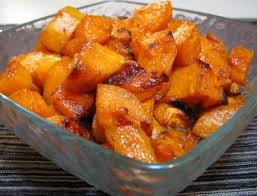
I like the classic chunks of sweet potato with
brown sugar--marshmallows optional.
I opened this blog post with a description of the people you expect to see in a food pantry line...people who are ugly, disabled, smoking, in need of a handout. But I hope you see the pain that was in that car, too, and in every car that came through that day--about 400 cars in all in our impoverished community. Don't ever say to me that it's well-off moochers coming to the food pantry until you have spoken to the people in every car through the line.

I was especially interested in the food recipients because in the past year I heard comments from many people about the food "handouts" and about people who have "too nice of cars" to need food assistance; and fielded questions about how the recipients are screened to weed out "people who are just looking for a handout"; and heard one too many "why don't they get a job" statements.

Yum. Judy Graybill--are you eating them right now?
First, let me back up. Under hero-director David Graham and his hero-volunteers, our largest local pantry (Methodist CARE Outreach) has, yes, gone to a drive-thru system. The young people I work with at my day job (and the program for which I was handing out flyers) actually helped convert a large aluminum carport into a drive through lane (they helped install a giant ventilation fan). No one has to park, get out of his car, take a cart around to gather food items, then return to her car to unpack it all into the trunk or back end of a vehicle.The drive through line has speeded up the distribution of food, but it also means that "regular" citizens (of course getting no public assistance--medicare anyone? home mortgage tax deductions anyone? Pell grants anyone?) driving along the streets can see exactly what each car in the food distribution line looks like.
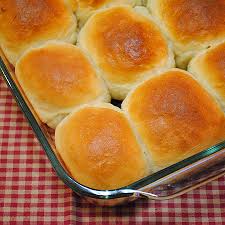
I always think of my Grandma Bessie
Dickerson when I eat yeast rolls. Thanks,
Robin, for carrying on the tradition.
Second, let me back up. Probably some people are scamming the system for food. So what? So we don't feed hungry people? I would rather feed 20 undeserving people than for even one needy person to miss getting food. It's food. It's not gold. I can't judge someone who is cadging food. I know from my upbringing that free food is very hard to resist. Even when I am not needy and not hungry, I feel like I should grab some and stash it somewhere. My brain overrides this impulse most of the time, but it comes out in weird ways, such as the monstrous-huge collection of free pens I have from trade shows and such. When I die, they'll find 3,000 pens stashed in coffee mugs all over my house. Just saying, I am not in a position to critique anyone's behavior.

Plus, it's not gourmet. Canned vegetables. The apples a bit too ugly for Giant Eagle's beauty contest. Off-brand cereal that was left on the shelves for good reason. Sometimes something odd, like a 12-pack of spearmint gum or a 20-ounce bottle of artificially flavored maple syrup. That's the high reward of stealing from the food system. Better to stake out cars at Krogers!
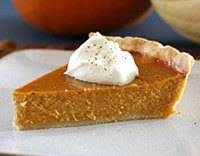
Wait--I want more Cool Whip!
"Well, if they can afford a Suburban, what are they doing getting a handout for food?"

Here's an answer. A lot of the people who qualify for the food distribution borrow a car. Or, a kind neighbor or family member drives them. Or, they share a car with other recipients. Or, a case worker, home health aid, or caregiver brings them. Regardless, each recipient has to show his or her card, which is verified by a volunteer. A colored strip is placed under the windshield wiper of each car to indicate how many allotments that car gets (a family of five gets more food than a person living alone, for example). Then the car proceeds through the drive-through's tunnel of food, where volunteers put the right amount of each item into the car. It's cool to watch--and, as I mentioned above, especially cool to see the respect and good cheer handed out with the food (I'm sure that adds to the food's nutritional value). If an allotment is two cans of corn, then a family with 5 allotments will get 10 cans of corn. That's how it works. By the time the car reaches the street, it is full and can motor off home.
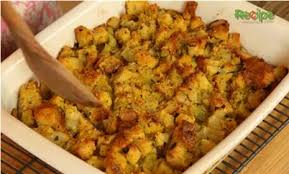
Moist, sticky, bready, with oysters, from a box or
hand made--love my stuffing.
In addition, the cars may look good from the outside, but they are not running that well. The smell of gasoline and exhaust fumes indicated inefficiency. The windows don't go up and down anymore. The door is wired shut. Many cars had distinctive pings, rattles, rumbles, and ka-chunks. These were not great cars. I know. I was checking on that for you. The better cars were mostly those of volunteers taking people through the line.

Listen. The faces of people who need food have a type of strain to them that I learned to recognize when my day job started providing breakfast and lunch to participants. Hunger takes the humanity out of a human. You can't sing and be hungry. You can't learn and be hungry. It's hard to be courteous and be hungry. The general cheer of the recipients in the CARE food line is a tribute to each and every volunteer who helps to bring them food. They honor and dignify the suffering of each person as the food goes into the car.
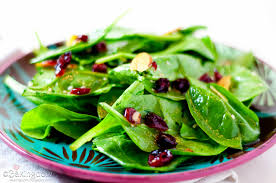
Salad? You served salad? What were you
thinking????

SIDEBAR: VOLUNTEER!

For most middle class and above people, the distribution of food to the poor happens outside our awareness. We don't see these people and sometimes we see them but invisibilize them. But, they are the least among us, as in "the least of these my brothers." Take a vacation day and volunteer at a food distribution in your community. You'll find out how it works, who gets food, who "those people" are. And I'm sure you'll be awed by the dedication of the people who serve regularly at the pantry. "Feed the hungry." It's a pretty clear message.

SIDEBAR: PLEASE COMMENT

Do you know of any other food banks who do a drive-through? I'm only familiar with the ones here in the county. Please add a comment to this posting if you know of other innovative strategies for making the food distribution respectful and expeditious.

Monday, October 8, 2012

Easing the Pain of Poverty, Part 4

Reminder: This is the fourth in a series of blog posts about easing--not ending--poverty. What can we do to make life easier for poor people? I've let my mind roam on this topic, discussing it with others, sharpening my observation of life around me. So, here we go again.

Also, remember that I'm not at all concerned with implementation of these ideas, nor do I claim them as original. I'm just answering the question, "How can we make life easier for the poor?"

Free GED. It costs as much as $50 for people who earn the absolute lowest among income groups--people without a high school credential--to take a test. Them that have no pay must pay to play.

Why? Why do we place a barrier in front of people who have already been ill-served by middle-class oriented school systems, by the rootlessness of poverty (they move a lot), by the heinous mistake of getting pregnant, by lack of family or community support, or simply by one or two bad decisions made when they were young and, as the young so often are, stupid. Fifty dollars is a lot for a poor person to scrape together and feels more like a punishment than a fee.

Please note that I am dealing specifically with Ohio GED rules and practices. What's the policy in your state? Why don't you know?

The GED, or general equivalency diploma, serves as an alternative to high school (although people in high school are not generally permitted to take it). It signifies that you have learned a core knowledge somewhat equal to a high school diploma. The five parts of the Ohio GED are reading, writing, mathematics, social studies, and science. The Ohio test is being revised.


I propose that the GED be free. No ifs, ands, or buts. And that an online course of study be developed and offered free also. Society will be paid back a hundredfold by this investment in often highly-motivated people. Let's (right this instant) remove any and all barriers between needing a GED and getting a GED.

A note to schools: please do not denigrate the GED to your students--it makes them feel trapped and as though they will be branded a LOSER for the rest of their lives. The GED is well-received in college admissions offices and by employers and is harder to pass than high school standardized tests (and no accommodations are permitted).

The Free Fleet I propose a fleet of hybrid or electric Priuses, Civics, and/or Focuses.be made available to poor people. Gas pricies have hit poor communities hard. In some cases, gas costs more than a person actually earns. Local jobs are scarce, so to be employed you must drive (and drive...and drive). It's a tough expense for people with good jobs, but nearly impossible for the poor who are clustered in low-paying jobs. Financially, it's a toss-up--if you work, you have no money and if you don't work, you have no money. In many cases, it doesn't make sense to work.

I don't believe that being poor and being lazy go together. To outsiders, though, I'm sure it looks that way. I regret that. When I see people lined up to get into federal jobs programs, people calling me to see if I've heard of anybody hiring, adults in their mid-twenties calling to see if they can get back into a jobs program for youth--when I see these, I know that the people in my community are not lazy (not lazy disproportionate to any other group of people). However, even the programs I know often require driving--having a car, having a functional car, having a driver's license, having gas money. I'm not even suggesting auto insurance here.

A fleet of small cars with high gas mileage would allow people to get to where the jobs are and to begin to drive out of the deep hole they're in. I know that lots of programs are working on this and lots of ideas are being floated. How about this: If you get a job, we'll get you a car, a decent car with a good repairs record. You can keep it as long as you keep working. That's it.

Environmentally, it would be cool to try out a fleet of electric or hybrid cars in a defined opportunity zone, such as McArthur, Ohio, to Chillicothe, Ohio, or McArthur to Jackson, Ohio. Plug-in stations would be easy enough to install. And with our focus on tourism and natural beauty, efficient cars would make sense. Car pooling would also be great, but I don't see why we should expect the poor to be more virtuous than the rest of us individual car owners who travel 90% of the time without passengers. It's the American way.

Is this pie in the sky thinking? Yes. Would this be difficult? Only if we make it difficult. Why should we care? All I can say is that I care. Poor people are not abstractions to me--they are my neighbors, friends. They love, they mourn. They are trapped. I care. I don't believe we can write anyone off as useless. I am so fortunate. I have been directed in my life to the golden crossroad where good luck and good preparation intersect. I'm lucky, and I was well-educated by luck. It wasn't my superior efforts toward achievement that kept me out of poverty. The Christian tradition (and most other religious traditions) says to tend to the sick, the poor, the grieving, the prisoners, to demonstrate a loving kindness. My job right now seems to be writing about poverty.

I had to call people the other day to tell them they did not have jobs. The flatness in their voices, the long pause before they acknowledged the news...those were people I cared about, many I knew. I'd like to give them each a Prius. A shiny red one. With a full tank of gas.


Saturday, September 22, 2012

Poverty: Easing the Pain, Part 3

This is the third entry in my series about how to ease the stresses of poverty on the poor. From my experiences in two different poverty simulations, it is clear to me that the conditions of being poor in the United States often ensure that poor people will remain poor and that poverty will be an untenable way to live. I'm not trying to end poverty. Please read my previous posts about poverty to get more background on this series. Now, back to my list of suggestions.

Second Poverty Simulation At a recent conference, I went through a second poverty simulation. In structure it was identical to the first one I did. In my own role, though, this was a totally new experience. In my first simulation, I was a "provider." I dealt with the poor, but I wasn't one of them; I was the mortgage banker. This time I was poor--a breadwinner mom with three kids (one of them pregnant) and a laid-off husband. I thought I knew what it would be like. NOT!

Well before the whistle started the simulation, my family and I were deeply into how to get things done. Our pace of speech quickened. We passed materials around and dropped them and picked them up backwards. From my first experience, I knew that many families in the simulation would not get their families fed, so I made it my personal priority to get food every week (15 minutes) of the simulation. For the first seven minutes of the week, I had to go to work, then I needed to cash my paycheck, get gas (transportation vouchers) for the next week, and go buy food.

My youngest child--the one who was
removed for neglect--was a stuffed bear.
My family started off with only enough transport vouchers to get me to work and one other place--I had to go to the only place you could get vouchers: the quicky loan place--and I had to cash my check there, with the userer taking up to $30 per hundred of my pay. Still, I could get vouchers and that would get me over to the grocery store to get food. By the end of this sequence, there was no time left in the week. I left most of the other needs of the family to the others after pretty much throwing the spare vouchers at them.

My family did OK. Dad and the sixteen-year-old were both able to do things during the day. We got food every week (OK, partial in week 4) and paid the mortgage and car payment. One of our children was removed from the home for neglect (she got left behind) and we were almost callous about it. Dad went over to see about getting her back; there was no one supervising her so he just brought her back home. I also found that I did a horrible job at work (we had to fill out surveys). My mind was not on the work--it was on what the rest of my family was doing, whether there would be a long line at the quicky loan place, which place was closer to the quicky loan place--the mortgage place or the JFS, would my husband get us some food stamps this week... My handwriting on the surveys sprawled all over the place and I wrote down random responses. Not the model employee, but my family did eat.

Get the churches together I wish that the preachers in my county--anyone who considers him or herself one--would get together and talk about what they see in their congregations. Some will report hunger, others wealth. Some will report despair, others hope. Together, they could direct resources for the assistance of the poor.

In my rural community we have lots of churches, mostly small and self-started organizations, meaning that a man (usually) who feels the call starts his own congregation or spins one off from another church or takes over an existing church. These churches come and go, strengthen and weaken, and are not affiliated with any major protestant religion. In the villages (no place in the county counts are a city), we have actual denominations--Methodists, Baptists, Freewill Baptists, Episcopalians, Presbyterians, Catholics, Community of Christ. However, the denominations struggle with attendance levels and are also dependent on the personality and/or leadership skills of a particular preacher.

The local preachers I know are decent people--even the ones who would consider me the Anti-Christ if they knew the membership cards I keep in my purse. I know of one small group of these ministers meets regularly--primarily pastors from mainstream denominations--and can assess community needs. In larger rural towns, ministerial associations can be a major voice that calls attention to needed changes and reforms for the poor.


Poor on the board Organizations who help or make money off the poor should be urged or mandated to include some poor people on their boards. The boards I have been on (and the one that is my boss) are made up of middle class to upper middle class professional people with college degrees. We talk about the poor as though they were an abstraction--and to many of us the poor are an abstraction. We make programming decisions and funding decisions that affect them without consulting them. Board members are generally people of good conscience who reflect the goals of the organizations they direct. But they may lack in their knowledge of other sectors of our society--well-off people would certainly not want boards made up of only poor people to make rules and decisions for them!


The Twelve Socioeconomic Levels - United States

Thinking in terms of lower, middle, and upper class Americans is an oversimplification. I like the dirty dozen given in this list. I pasted this from someone's Facebook post--if you can verify the source, I will gladly give the author full credit. I used to be an 8, but have sunk to a 4 through medical expenses and illness. I have hope of hopping back to 8 someday with the support of my education and family support, just like most 4s.

1. Generational Poverty - The harsh conditions of this type of poverty may keep these families from breaking the barriers for generations.

2. Working Poor - These families live paycheck to paycheck, often in fear of being laid off.

3. Working Class - Generally these workers have more stable employment than the working poor. They may use their hands and bodies as a primary tool to do their work.

4. Situational Poverty - A crisis (e.g., health, divorce, etc.) results in an income drop causing these situations. They generally make it back to middle class due to assets such as education, family support, etc.

5. Risen from Poverty Middle Class - They have gained some resources. They often become the “safety net” for others (their immediate family, friends, etc.).

6. Illusory Middle Class - These Americans have houses, cars, TVs, etc., but they also have staggering debt associated with each possession.

7. Lower Aspiring Middle Class - Adults imitate neighbors with consumer purchases. Going to college is emphasized with children although they may not have gone to college themselves.

8. Solidly Middle Class - They own their home and have investments or business. Assume children will be college graduate/professionals.

9. Upper Middle Class - They have a higher income due to professional jobs and/or investment incomes.

10. Millionaire Middle Class - They have a net worth of over a million dollars, but have not mentally accepted their wealth.

11. Owning Rich - They own income-producing assets sufficient to make paid employment unnecessary.

12. Ruling Rich - They hold positions of power in major institutions of society and may live secluded lives or are protected from the general public.

Tuesday, August 28, 2012

Poverty: Easing the Pain, Part 2


NOTE: This entry continues two previous posts--"Poverty Sim: Walk in My Shoes" and "Poverty: Easing the Pain, Part 1."

REMINDER: The ideas included in this blog post are not terribly new—most have been at least attempted. And, keep in mind that my goal in sharing these ideas is NOT to end poverty, but simply to remove some of the stresses that are added to poor people’s lives because they are poor. Most of these ideas are met with skepticism, others with outright hostility. Alas. I can’t let a negative reception keep me from putting all of these ideas together in writing in a publicly available forum.

ODJFS: Burn-out prevention Thanks to cutbacks in almost every program for poor people, county Job & Family Services departments across the state are under great stress. They have laid off workers to cut their budgets at the same time that the number of people requiring services has soared. This puts the remaining workers—the ones charged with helping the poor—under great stress.
          I call upon my own memory of the poverty simulation I participated in recently. I was the mortgage banker in this valuable role-play experience, collecting rent and mortgage payments from poor people. The rapidity with which I developed an intolerance and even a scorn for the people I served was shocking to me. It was stressful to see that I was powerless to help and was often the agent of pain for my customers. I don’t know if this bears on the stress carried by JFS caseworkers, but I have seen some workers treat some clients with the same rudeness and eye-rolling that came over me in the simulation.
          These workers need help. They need a plan for burn-out prevention. I don’t know what the plan would be—massages at work? Weekly debriefing sessions? Free coffee and bagels every morning? New desk chairs? (OK, the desk chair thing is personal—I know a new desk chair would be valuable to me personally.) I think regular infusions of food from our local wunder-chef, Chef Mary from Flutes & Peppercorns, would be a welcome stress reliever. Anyway, something needs to be done for these dedicated professionals to help them feel like something other than a paper-pusher or payment policer.

Expand OBB (Ohio Benefit Bank) The Ohio Benefit Bank (OBB) is a wonderful computer program that determines likely eligibility for various programs, from food stamps to FAFSA, from TANF to tax filing. (TANF is “temporary assistance for needy families,” pronounced TAN-iff.)  Individuals may process themselves through the OBB program, but usually a trained volunteer guides the data collection and entry. OBB is a one-stop application process; applications are generated and sent directly to appropriate agencies, whether it is for your Golden Buckeye Card or for WIC for your baby.
          OBB can be used anywhere there is a computer and internet service (like our shiny new McDonalds in McArthur). Or, it can be used at your bedside at a retirement home. Or, you can use it by yourself on a computer at the library. The casualness of the settings removes barriers for many people, especially people who are dropping painfully out of the middle class and cannot face going “up on the hill” (as we say about Vinton County’s JFS) to apply for assistance.
          Some Job & Family Services offices see OBB as a competitor—something that is eroding their authority. OBB counters that the program only allows people to apply for benefits more easily—JFS still has total control over determination and administration of benefits. I hope that these two entities can find a way to co-exist or even cooperate in bringing services to poor people.

Appalachia last in line: 2-1-1 The twenty or so counties who still do not have 2-1-1 information line service are all in counties designated as poor and Appalachian. The Appalachian counties that do have 2-1-1 are often serviced through neighboring non-Appalachian counties—and that’s fine.
          But a county like Vinton is surrounded by other struggling counties. Who is going to step up? Where is the funding going to come from? The United Way is the implementer of 2-1-1 in many counties, but my United Way only has one part-part-time employee—me.
          I think It’s funny that between United Way and my other employer, I am sort of a mini-2-1-1, a referral service to a range of callers. And my efforts pale compared to the real 2-1-1 woman in Vinton County—Brandi Betts of the Chamber of Commerce. Thank you, Brandi, for your patience with so many random requests for information.
          2-1-1 would assist every resident to navigate among care providers, find the food pantries, find Sojourners for runaway and homeless youth services or for Youthbuild or work programs. 2-1-1 would focus only on helping and not be torn by numerous other responsibilities. When are the poor people of Appalachian Ohio going to get it?

Subsidize family activities: The free ride I remember from my own impoverished childhood what it felt like to  be left out, what it meant to never go to the amusement park everyone else was excited about, to never ride the rides at the county fair. That’s just one reason I am proposing that we find ways to subsidize rides at local events such as McArthur’s Wild Turkey Festival (no, not THAT kind of Wild Turkey) and the Vinton County Junior Fair.
          When I mention this idea, many people respond with outright hostility. They refuse to consider it. As I often observe, there is a feeling that the poor must be punished for being poor.
          But I insist. Let’s find funding for all children to ride free. It shouldn’t be necessary for families to sacrifice food or rent money to make sure their kids can ride the rides.
         In Vinton County, where 90% of schoolchildren qualify for free lunch (highest percentage in Ohio), the school district recently decided to just give free lunch to every child. Everyone gets to eat. No more stigma of being identified as one of the free lunch kids. This generous act may have been the result of financial realities, but it is the free lunch for all attitude of the schools that made me think about free rides at local events. Now, where do we apply for the free tilt-a-whirl grants?

My parents used a pencil and
ruler to make their own
spreadsheet.
Sidebar: The Frugal Poor--My Parents
          My family was poor--poorer than my sisters and I really understood. As with all children, our own family was the norm--we couldn't believe what went on in other families! Others were "less" normal than us.
         What set my family apart from other poor families is that my parents had a plan. From their church, they learned about budgeting and tithing and record-keeping. (To figure your tithing, you had to keep track of your income and expenses--sort of like God was your shareholder.) We always asked whether something was a necessity--and the opposite of "necessity" was "no." There was always a big sheet of paper magnetized to the fridge, on which my mom or dad would record anything we spent individually or as a family. This was a good thing and kept us off public assistance and kept us housed, clothed, and fed. We even had some savings. 
         However--yep, there's a "however"--the budget of my parents didn't allow for much extravagance in the fun-having department. Our gifts from Santa were a bit on the practical side (while our poorer neighbor kids received a lavish haul every year--we were jealous). And only once do I remember going on a non-church-camp vacation. (We hardly knew what to do with ourselves.) And we seldom rode the rides or saw the latest Disney movie.
We always got "books" of Lifesavers for
Christmas--and socks and underwear, of course.
         I felt that I was privy to some deep knowledge in terms of how my parents handled money. I knew my parents were doing the right thing. But I hated it. I had wants that just wouldn't go away--my wants had way more to do with not seeming peculiar than about a deep urge to ride a Ferris wheel or eat an elephant ear or see a movie. I became my own outcast, went about in my own world, became mentally inventive, grew into a writer. But I have never lost the outsider mentality fostered by my parents' budgeting zeal (and other family peculiarities, of course). I'm pretty frugal, too, and it has kept me marginally afloat during the past several lean years. But it's still not fun. Free rides would be great.